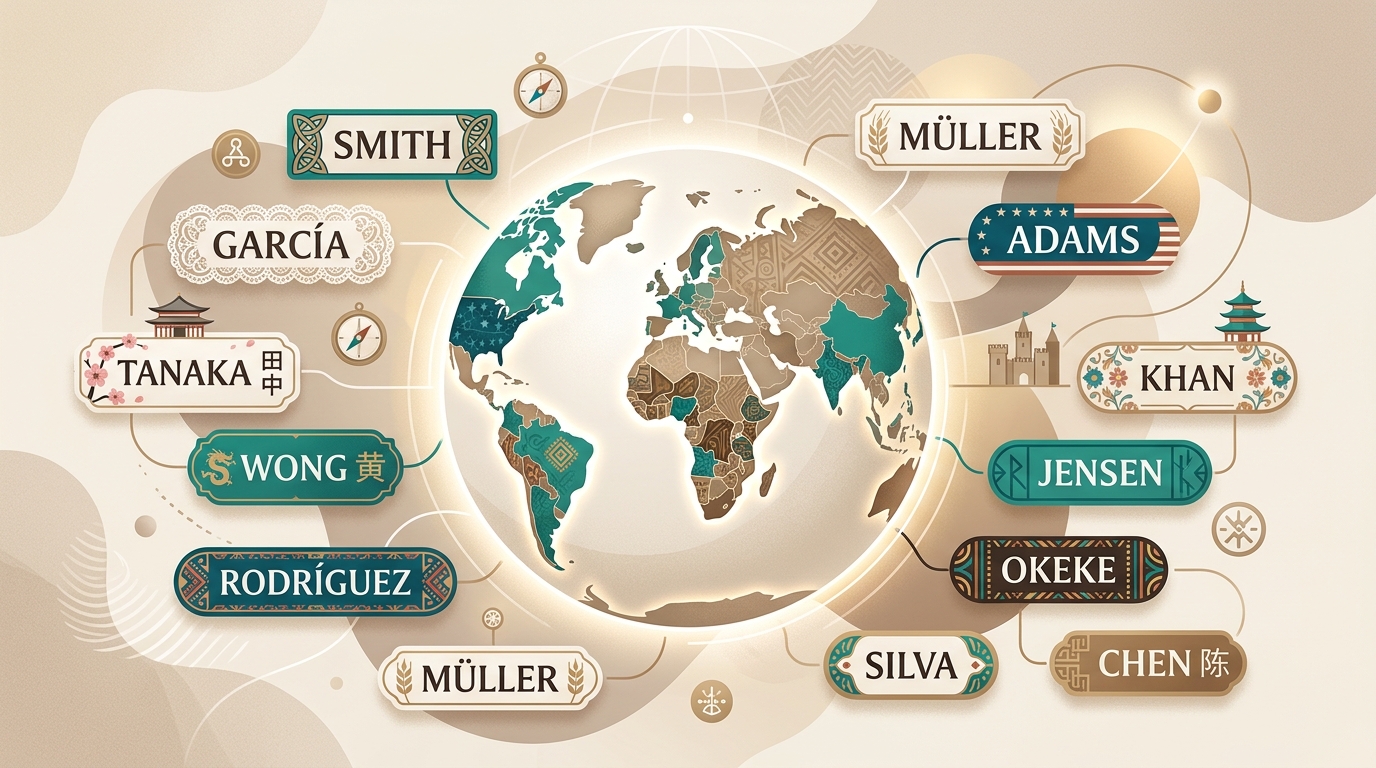
Last names are more than identifiers — they’re compressed histories. Every surname carries echoes of an ancestor’s occupation, location, physical trait, or family lineage. Understanding where surnames come from enriches our appreciation of the names we encounter daily.
How Surname Systems Developed
For most of human history, people got by with a single name. Surnames emerged independently across cultures as populations grew and single names became insufficient for identification. The transition happened at different times in different places — and through remarkably different mechanisms.
Patronymic Names
Many cultures built surnames from a father’s (or occasionally mother’s) first name. This is one of the oldest and most widespread surname systems.
- Scandinavian: “Johansson” means “son of Johan.” Traditional Scandinavian naming was purely patronymic — each generation got a new surname based on their father’s name.
- Irish: The prefix “O’” means “grandson of” (O’Sullivan = grandson of Sullivan), while “Mac” or “Mc” means “son of” (MacCarthy = son of Carthach).
- Arabic: “Ibn” or “Bin” means “son of,” creating chains like Ibn Rashid (son of Rashid).
- Slavic: Suffixes like “-ov” (Petrov = of Peter) or “-ski” (Kowalski = of the forge) often indicate patronymic origin.
Occupational Names
In medieval Europe and beyond, what you did for a living became your identity.
- English: Smith (metalworker), Fletcher (arrow-maker), Cooper (barrel-maker)
- German: Kaufmann (merchant), Schreiber (writer/scribe), Jäger (hunter)
- French: Chevalier (knight), Marchand (merchant), Fontaine (fountain keeper)
These names are fascinating because they freeze a single ancestor’s medieval profession in amber, carried forward through centuries even when the original occupation has been forgotten.
Geographic Names
Where you lived or came from could become your name, especially when people moved to new communities.
- English: Ashford (ford near ash trees), Westbrook (western brook)
- Italian: Napolitano (from Naples), Lombardi (from Lombardy)
- Japanese: Yamamoto (base of the mountain), Tanaka (middle of the rice field)
Descriptive Names
Physical characteristics, personality traits, or notable features sometimes became permanent identifiers.
- French: Moreau (dark-skinned), Beaumont (beautiful hill — perhaps someone who lived near one)
- German: Breitenberg (broad mountain), Grunewald (green forest)
- Korean: Kim (gold), Park (gourd), Choi (summit)
Regional Surname Patterns
East Asian Naming
Chinese, Korean, and Japanese surname systems are among the oldest in the world. Chinese surnames (like Chen, Wang, Zhang) predate most European surname systems by millennia. Notably, the surname comes first in these cultures — family identity takes precedence over individual identity.
African Naming Traditions
African surnames vary enormously across the continent. Many reflect clan or tribal affiliation (Nkosi, Zulu), while others were influenced by colonial languages (Vieira from Portuguese colonialism). Some carry deep meanings: “Adeyemi” (Yoruba) means “the crown befits me.”
Arabic Naming Conventions
Traditional Arabic names are complex chains: personal name + patronymic (ibn/bin) + family name + tribal name + geographic descriptor. Modern usage has simplified this, but names like Al-Rashid, Khalil, and Mansour carry centuries of cultural weight.
What Surnames Tell Us Today
In an increasingly globalized world, surnames remain powerful markers of heritage. They connect people to their ancestors’ stories, even when those stories have been forgotten. A person named Kowalski may never have worked a forge, and a Nakamura may never have lived in the middle of a village — but their names still carry those ancestral echoes.
Explore surnames from 16+ cultural origins, or dive deeper into naming conventions from cultures around the world with our free tools.